Broadband 1:1 Current Balun

$100
Best for Dipoles and other balanced antennas with impedances close to 50 Ω.
This Balun covers the entire HF spectrum from 1.8 MHz to 30 MHz, has very low loss of <0.09 dB, handles 1500 watts, and is fully weatherproof.
Current Baluns are sometimes referred to as Choke Baluns. This Balun is a Black Beauty Broad 160-10 Common Mode Choke repackaged so it can easily be connected to wire antennas as a Balun.
This Balun matches a 50 coax to a generally balanced 50-75 ohm antenna, such as a dipole or yagi. By reducing common mode current, it reduces RFI, improves signal strength, preserves the antenna's radiation pattern, and decreases received noise.
* Sealed and can be mounted in any orientation
* It can be mounted to a solid surface with screws, or
* hung by the top eyebolt, or
* suspended between the side eyebolts, or
* attached to a mast or boom with U-bolts using one of our Mounting Kits
Broadband 4:1 Hybrid Balun
$120
This Balun is best for Loops, OCFD Off Center Fed Dipoles, Folded Dipoles and any other antenna that presents a feed point impedance of around 200 Ω.
It covers the entire HF spectrum from 1.8 MHz to 30 MHz, has very low loss of <0.12 dB, handles 1500 watts, and is fully weatherproof.
The Hybrid Balun combines the best of both worlds: Voltage Baluns and Current Baluns. It is comprised of a Ruthroff 4:1 Voltage Balun followed by a broadband Common Mode Choke (also known as a Current Balun or Choke Balun).
It matches a ~200 Ω antenna to a 50 ohm coaxial cable feedline AND balances both the voltage and the current in each leg of the antenna. This makes it especially desirable for use with Off Center Fed Dipoles (whether Horizontal or Vertical) which are, by their nature, unbalanced - and tough to balance.
Because the antenna is matched and balanced: SWR, CMRR, and signal strength are increased while common mode current, RFI and received noise are all reduced.
* Sealed and can be mounted in any orientation
* It can be mounted to a solid surface with screws, or
* hung by the top eyebolt, or
* suspended between the side eyebolts, or
* attached to a mast or boom with U-bolts using one of our Mounting Kits
Broadband 4:1 Ruthroff Voltage Balun

$100
This Balun is best for Loops, OCFD Off Center Fed Dipoles, Folded Dipoles and any other antenna that presents a feed point impedance of around 200 Ω.
It covers the entire HF spectrum from 1.8 MHz to 30 MHz, has very low loss of <0.12 dB, handles 1500 watts, and is fully weatherproof.
It matches a ~200 Ω antenna to a 50 ohm coaxial cable feedline and forces the voltage on the two legs of the antenna to be equal. It also reduces common mode current on the feedline, but not as well as a current balun. It is often used in conjunction with a Common Mode Choke.
* Sealed and can be mounted in any orientation
* It can be mounted to a solid surface with screws, or
* hung by the top eyebolt, or
* suspended between the side eyebolts
* attached to a mast or boom with U-bolts using one of our Mounting Kits
1:1 Current Balun
Excellent CMRR
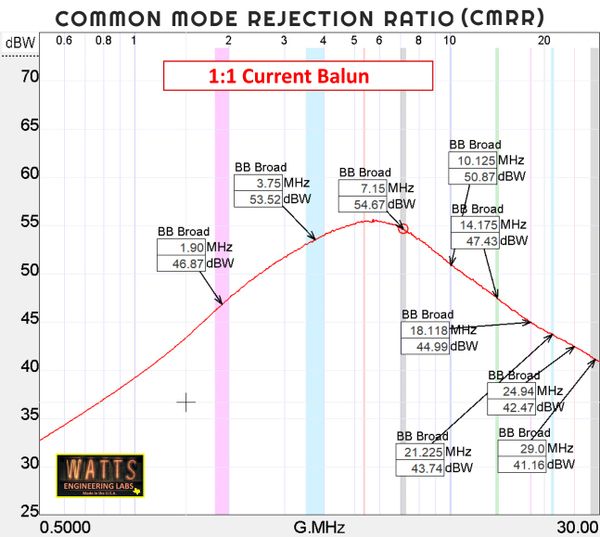
The excellent Common Mode Rejection Ratio (CMRR) of the 1:1 Current Balun means it balances the current in the two legs of the antenna and rejects common mode current - all in one device.
Very Low Loss
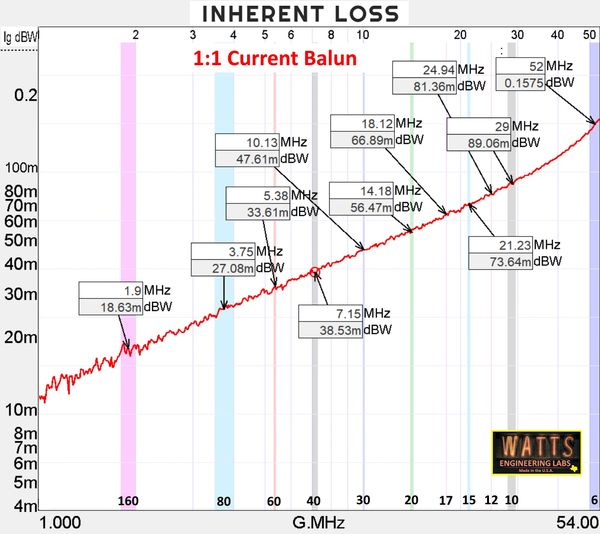
The very low loss of our 1:1 Current Balun means none of your signal is wasted and internal heat generation is very low. Great for high power situations.
Ruthroff 4:1 Voltage Balun Measurements
Modest CMRR by Itself - should be followed by a Common Mode Choke

A Ruthroff 4:1 by itself will provide a very good 4:1 transformation, but will not do a very good job of rejection common mode current. But is quite food when followed by a good Common Mode Choke.